
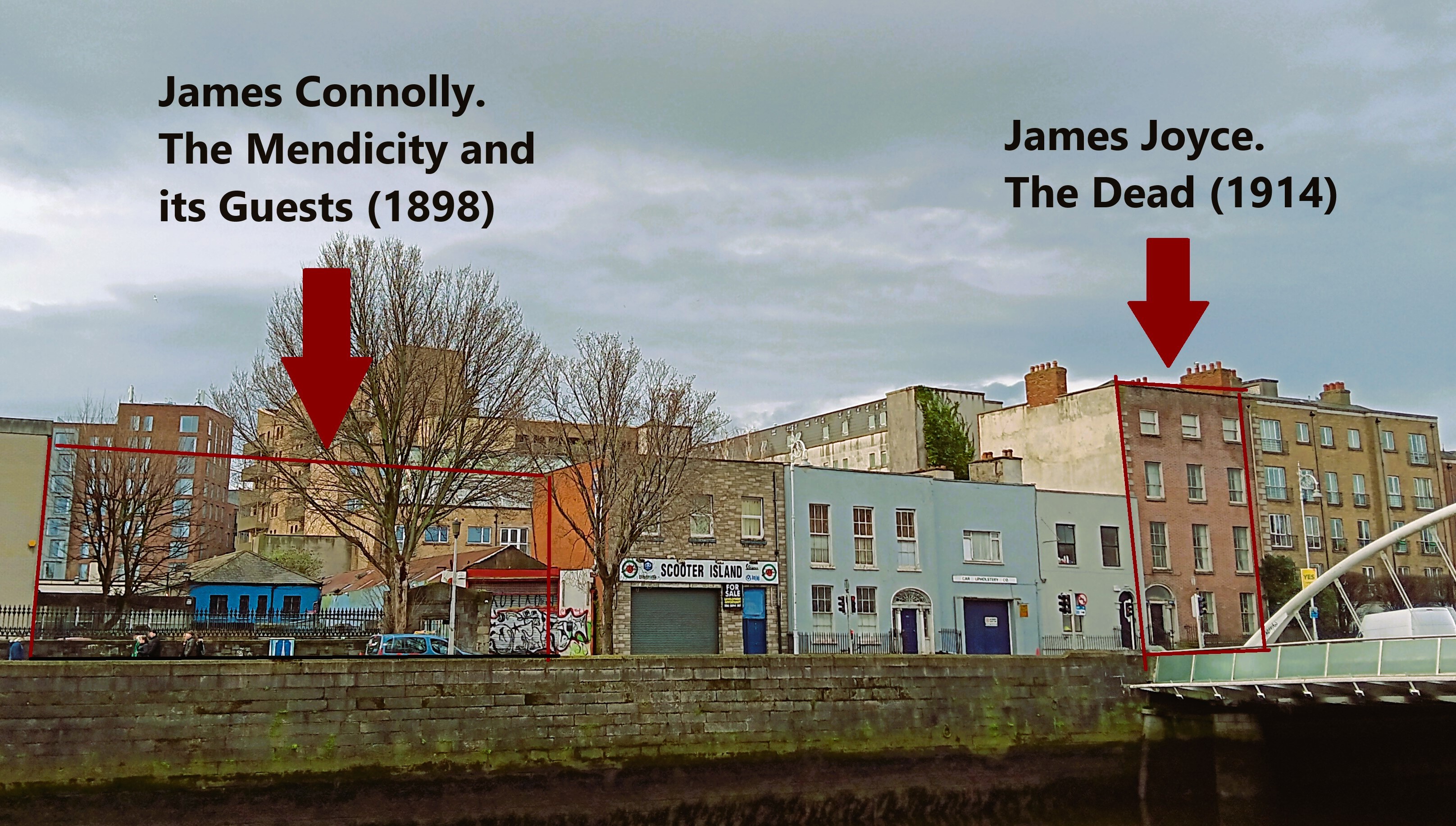
One of the joys of undertaking to edit James Connolly’s early writings was the discovery of three previously unknown short stories which I came across through an extensive trawl of the archives.
Up to now his only known short story was ‘The Mendicity and its guests’ which was published in Worker’s Republic, 27 August 1898 and forgotten about until republished by Red Banner in March 2009.
Desmond Greaves wrongly calls it “A Night at the Mendicity” – a title he got from Desmond Ryan who edited Connolly’s writings in the 1940s along with William O’Brien and who told Greaves that the story “had to be suppressed.”
The protagonist of the story is homeless and without work or funds, and is clearly based on Connolly himself. Indeed, his earliest biographers referenced Connolly’s time as ‘tramping’ in Dublin and this may have been the reason why Ryan/O’Brien hid the story from public view.
One of the short stories I have rediscovered, though, is in a similar vein and seems to support the view that Connolly was indeed homeless in Dublin in the late 1880s before he returned to Scotland.
Even Berresford Ellis, in his 1973 edited collection of Connolly’s works, is unaware of its title and gets the publication date wrong – which raises questions over the research Ellis undertook as the story was at that stage freely available to view in the National Library.
However, an interesting geographical aspect to the Mendicity story is that the institute referenced in the title was about five doors up from the house where ‘The Dead’ by James Joyce is set.
Joyce once famously said that if Dublin was destroyed it could be reconstructed from the pages of Ulysses.
It’s a good line and shouldn’t be taken too seriously but of course Joyce’s Dublin is essentially the Catholic middle class Dublin on his youth.
The working class are rarely present, and when they are it is often as non-player characters.
Connolly and Joyce were of course contemporaries, both obsessed with Dublin, and both spent their lives writing about it in myriad ways.
The class-conscious eye of both, though, couldn’t have been more different. The working class Dublin of Connolly’s journalism is a million miles away from the parlours and Martello towers of Joyce.
This is no criticism of Joyce, who wrote brilliantly, but hopefully when the edited collection comes out this autumn Connolly’s writings on the lives & struggles of the working class of Dublin at the turn of the 20th c. will finally get the recognition it deserves.
 Conor McCabe
You must be logged in to post a comment.